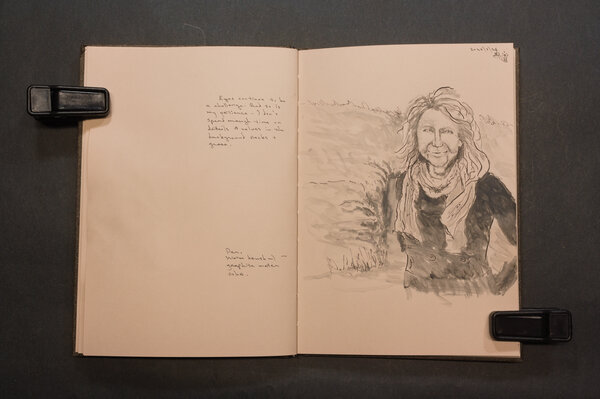
I'm too lazy to post every sketch and painting I create. Here's what I do post.

I've done 30 posts. At the rate of 0.19 posts per day, in 14,409,741 years I'll reach a billion posts. Yay me!

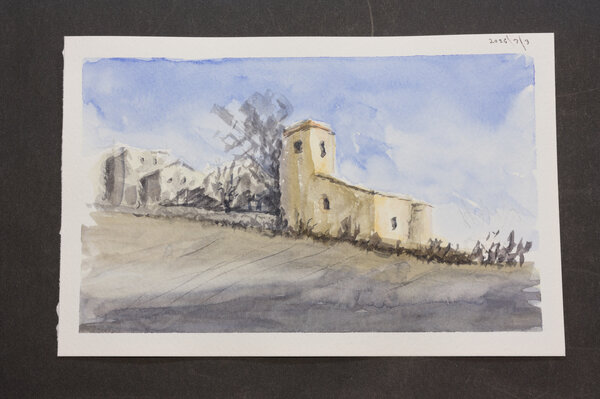
One attempt at a watercolor of an old mission style building with a tower and rounded corner end, with a back drop of poor neighborhood buildings.

Buildings Are Supposed to be Easy to Paint. They're Just Boxes.

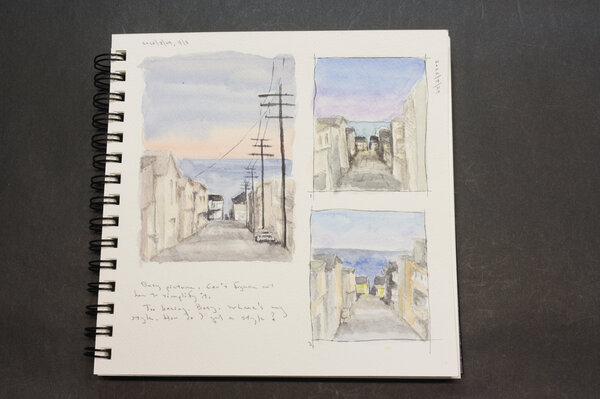
I watched a tutorial that was supposed to transform my buildings from boring to better. It took a few tries and... slightly better? They're just boxes, how hard can this really be? It's wild how something that looks so easy requires a lot of practice when the easy doesn't come natural. Also, bulldozers are cool.

Updated:
Created:
Versions: 3
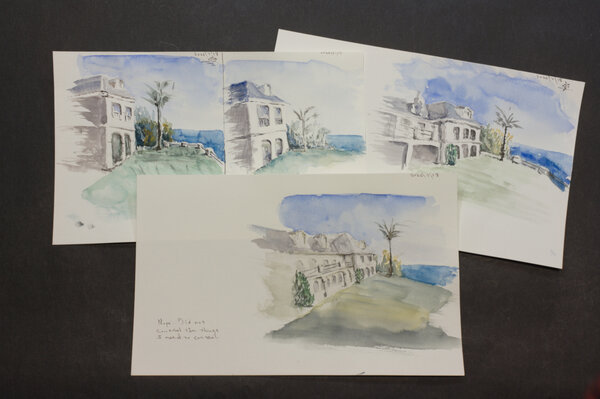
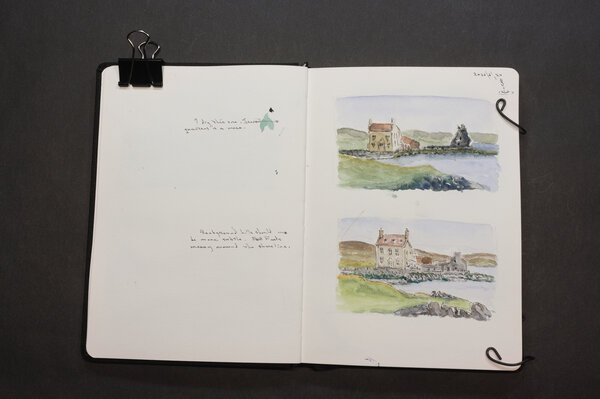
Two watercolor attempts at a Shetland countryside manor on a shoreline with a servants house extended off the main building. Giving up on this round. Slightly better than the previous ones I've tried.

Five Tries at a Scottish Seaside Scene in Watercolor, and No More Golf

Discouragement. It sucks the motivation right out of me. These five attempts at an old seaside manor were tough to do because I kept doing things that didn't produce the results I wanted. That's part of learning, right? I need to try and fail a lot. Fail repeatedly and hopefully learn from the mistakes. Also, a human in charge of capital golfs no more.

Updated:
Created:
Versions: 3
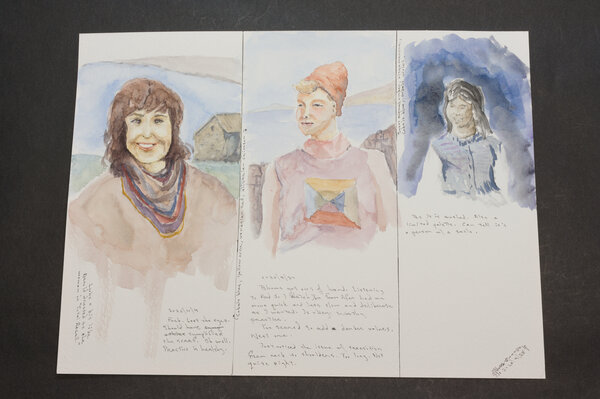
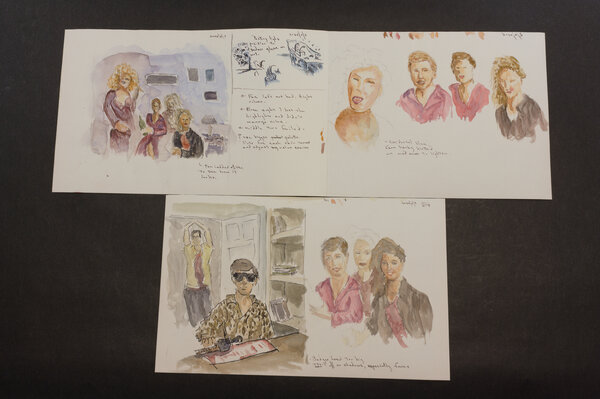
A couple of attempts at watercolor faces based on a video frame from the movie 'Better Off Dead' with Badger in his room with older, sexy women.

Faces Are Still a Challenge, Even with 'Better Off Dead' References

It gets easier to give myself room to play and not expect too much from what I try. And I sometimes use movies as sources of inspiration on what to practice, especially with faces which will remain a challenge for the foreseeable future.

Updated:
Created:
Versions: 2
Third attempt at a watercolor of a grazing pasture I pass by frequently. Picture taken in late summer. This version is pen and ink with watercolor where I went way too heavy on the watercolor and it ended up muted, muddy mess of greens.

Forgot the Body, a Watercolor of a Grazing Pasture

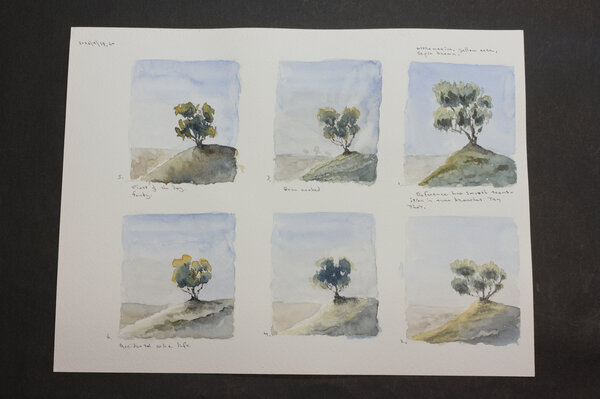
I pass by a beautiful grazing pasture with a small river frequently and, ever since taking up art, have wanted to paint it. This is my third attempt. I still have a lot of practice to do. Back to the original, did I intend to paint this pasture with the forethought it'd go on this site and be related with a story about wealthy death? No. And that's okay, too; my site, my rules.

Updated:
Created:
Versions: 3
A couple of watercolor sketches of people holding a flaming Molotov cocktail. One of a dark dressed guy in a hoodie. The other a baby in a stoller with mom kneeling next to her.

Neighborhood Molotov Cocktail Stand a Success

A neighborhood lemonade stand manned by children who sell Molotov cocktails. That was the idea. I initially tried and failed because complex scenes are beyond me. And that's okay, because I'll try again. Such as with the watercolor of matches which are an integral part of arming any Molotov cocktail. Then, a couple of months later, some watercolor sketches of people holding flaming bottles. Are they awesome? No. That stroller in the new version is WAY better than the stroller in the original. And that I am happy about.

Updated:
Created:
Versions: 4
Watercolor of a flight of stairs with a burnt ashy mark on one of the landing ones. A green border wall in the background with faceless heads in the far background.

I Pick Boring Subjects. Here's Some Stairs with Faceless Heads and Some Ash.

I guess this is more a practice of patience than anything interesting. The story was stuck in my head. I had to go with stairs at a gala type of event. And it's obvious from the noodly ascending lines for stairs there's room for improvement. Not that I want to draw technical stairs. There's visual tricks to make things in the distance a bit abstract, less defined, yet still obvious as to what it is. Things to learn.

Updated:
Created:
Versions: 2
Watercolor of a woodsy path with a grassy field on the right separated by a knotty wooden picket fence. Second attempt.

So Many Woodsy Greens; The Greens Won. And a Small-Town Wedding No More

When I look at some of the "simpler" watercolor nature paintings, I think "that's not so hard." And then I try it. And realize that "simple" isn't easy. I knew this, though. It's the brush strokes, they look like something I can ape. Two different greens next to each other give depth to a patch of grass, yet I try and it gets muddy somehow. Technique. Don't have it yet.

Updated:
Created:
Versions: 3
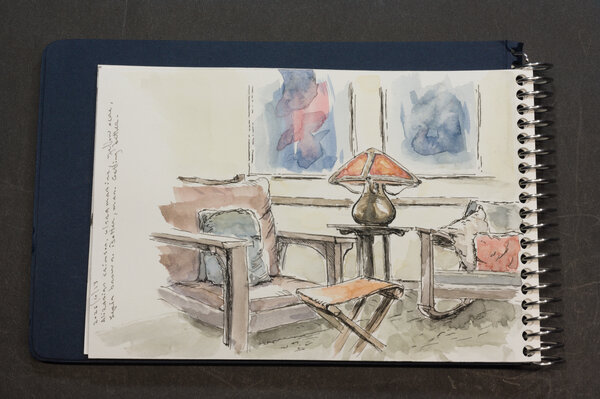
A watercolor of the elevator from 'The Shining' before the doors opened and blood came out. This version has the bottom elements fading downward, somewhat of a melting look of the chairs and black panel walls falling through the floor. Not very good interpretation.

Add Interiors to the Things I Have Trouble Painting. And an Elevator Attendant's First Day.

Sometimes I get an idea in my head and I see it through despite the idea's shortcomings. Like these attempts at "The Shining" elevator without the blood. How hard can painting an interior setting be? Well, shit. Three tries and I gave up. Not that I want to throw any of these away, no. They're going to the island of misfit artworks, like so many others.

Updated:
Created:
Versions: 3
Black and white graphite drawing of a whale tail breaching the ocean with a boat in the distance. A water brush was applied over the carbon pencil to produce smoother textures.

When a Tree Looks Like a Whale Tail, a Tale Can Be Told

After a recent video watch of using a water brush with a mix of permanent and non-permanent fountain pen inks, and then another video demonstrating a water brush with a carbon pencil, I ended up with some sketches. And the charcoal tree looked like a whale tail. Naturally, I had to try to sketch a whale tail breaching the brine. And then came the inspiration about our oceanic mammalian brethren.

Updated:
Created:
Versions: 2

More Entries:

Expand for a random shower thought with AI: Guillotine usage optimization?

Thought: What's the optimum guillotine (processing unit [PU]) usage for a summer concert season?

  • Google says there's about 1000 billionaires in the US. I'll label them "GU" for greedy units. For extra coverage, say each GU has 10 subordinate GUs (family units, business units). That gives us 10,000 GUs to process.
  • Wikipedia says there's over 2000 outdoor concert venues with 1000+ capacity. I'll go with 1,000 concert venues.
  • And 50 days of concert shows across those venues should be okay for a time limit.

Since I have access to an LLM and I'm lazy, I'll have it figure things out and assume it's correct. Here's the chat that cost $0.04.

Me

Please help with a calculation for optimal usage. I'm managing spectacle installations during this season's summer concert tours. I'd like to figure out how many processing units is optimal for the number of days and venues I have available. Here are my variables:

  • 10000 inputs, labeled "GU". This is fixed. These are fed into the processing units.
  • 1000 venues, labeled "V", where the inputs will be processed. This is fixed.
  • 50 days, labeled "D". Fixed.
  • How many processing units "PU" would we install at each of the 1000 venues to maximize PU usage over the 50 days?
LLM

Processing Unit Optimization

To maximize PU usage, I need to make some assumptions about how the inputs flow through the system. Let me work through this:

Setup:

  • *GU* = 10,000 inputs (total)
  • *V* = 1,000 venues
  • *D* = 50 days
  • *PU* = processing units per venue (unknown)

Distribution

  • Inputs per venue: frac{GU}{V} = frac{10{,}000}{1{,}000} = 10 text{ inputs per venue}
  • Inputs per venue per day: frac{10}{50} = 0.2 text{ inputs per venue per day}

The Optimization Question

  • To maximize PU usage (utilization rate), you want each PU busy as much as possible — meaning you want the fewest PUs that can still handle the workload.
  • If each PU can process 1 GU input per day, then: PU = lceil 0.2 rceil = 1 text{ PU per venue}
  • With 1 PU per venue, utilization = 20% (each PU works 10 days out of 50).

Caveat

Your question is a bit underspecified — I'd need to know:

  1. Processing rate per PU (inputs/day capacity?)
  2. What "maximize usage" means — utilization % (fewer PUs) or throughput (more PUs)?
  3. Are inputs evenly distributed, or can venues vary?
  4. Any constraints like queueing, parallelism, or deadlines?

Could you clarify the PU processing capacity and your optimization goal? That'll let me give you a precise answer.

Me

Good questions. Here's what I can speculate:

  1. Processing rate per PU (inputs/day capacity?)
    • Each PU can process one input per show. We can have multiple processing units at each venue. We should limit this to 3 - 5 per venue to maximize the spectacle.
  2. What "maximize usage" means — utilization % (fewer PUs) or throughput (more PUs)?
    • Maximum usage: with a maximum 3 - 5 PUs at each venue, one INPUT per PU per day.
  3. Are inputs evenly distributed, or can venues vary?
    • Inputs can be distributed however we want.
  4. Any constraints like queueing, parallelism, or deadlines?
    • We can run multiple PUs at the same time, only once per show per each one.

Does that help provide enough detail?

LLM

Yes, that's much clearer! Let me work through it:

Updated Constraints

  • Each PU processes: 1 GU input per show (per day)
  • 3–5 PUs per venue (spectacle constraint)
  • GU Inputs can be distributed freely across venues
  • PUs run in parallel, but each PU fires once per show

Capacity Math

  • Max capacity per venue over the tour: PU times D = PU times 50 text{ inputs}
  • Total system capacity: V times PU times D = 1{,}000 times PU times 50 = 50{,}000 times PU

Utilization at Each PU Level

| PUs/venue | Total capacity | Inputs used | Utilization |
|-----------+----------------+-------------+-------------|
| 3         | 150,000        | 10,000      | 6.67%       |
| 4         | 200,000        | 10,000      | 5.00%       |
| 5         | 250,000        | 10,000      | 4.00%       |
      

Recommendation: 3 PUs per venue

With only 10,000 inputs across 50,000 possible "slots" (1,000 venues × 50 days), you have massive overcapacity. Fewer PUs = higher utilization %.

However, since you mentioned spectacle value matters and 3 is the minimum, this is the sweet spot:

  • Maximizes utilization (6.67%)
  • Still delivers spectacle (3 PUs firing per show)
  • Leaves headroom for distribution flexibility

Alternative Framing

If you instead want to maximize spectacle (throughput), go with 5 PUs/venue and concentrate inputs at fewer shows — e.g., 2,000 shows at full 5-PU capacity, leaving the rest dark or running fewer PUs.

Want me to model a hybrid distribution strategy?